San Rock Art
Rock art traditions of southern Africa
Southern African rock art is a rich mix of traditions associated with different groups of people who painted and engraved on rock formations over thousands of years. Many of us think of southern African art as San paintings but there are another two major traditions that include both paintings and engravings.
In addition to San hunter-gatherer paintings and engravings and humans and other animals that occur throughout southern Africa there are two other traditions that have a more restricted geographical distribution and location in the landscape. These differ from San rock art in their subject matter, their location, style, technique and materials.
The Apollo stone, the oldest African rock art, 27 000 years old.
KhoiKhoi Plaas
Khoe-speaking herder rock art is generally found in the drier parts of southern Africa in Namibia and South Africa. It is thought to be linked to girls’ initiation into womanhood. The sites are usually very close to water. The art consists of painted and engraved patterns, shapes and depictions of headband, aprons, bags and ornaments.
Bantu-speaking farmer rock art was made by the descendants of groups that entered southern Africa from East and Central Africa from about 2000 years ago. The paintings and engravings differ according to the ethnic groupings who made them. Much of the rock art is part of boys’ and girls’ initiation rites. Examples include Northern Sotho initiation and ‘protest’ rock art (Limpopo Province), Southern Sotho boys’ initiation art, and settlement designs (Mpumalanga and KwaZulu-Natal).
Bantu tradition rock art at Boomplaats
The Aggtelek caves in Slovenia
The power of images
Painting and engraving images are practices that go back tens of thousands of years, long before the development of writing. Images were and still are an inseparable part of human life. They influence our feelings and thoughts without our being aware of it (think of advertising, social media influencers, and brand names). Images convey knowledge that cannot be described in words (Gibson 1979:272). They can be looked at again and again and they communicate knowledge to unborn generations of observers.
But at the same time, images do not speak for themselves, they contain meanings that that are not necessarily obvious. To understand images more deeply, you must know what they are about.
Landscape art
Rock art is different from other visual art because it is a landscape art. It is made ‘outside’ in the environment rather than indoors or on other materials such as paper, or bark. Rock art is part of the greater landscape. The rock is the canvas and the frame and cannot be carried away. The artists made a conscious choice about where in the landscape to make the images. These places often have great cultural significance.
Driekopseiland
Giraffe painting Ntswatugi Zimbabwe
Painting and engraving
There are two ways to make images on rock art: painting and engraving.
Painting involves adding paint to a surface. Paint is first made from a pigment (colour) which is mixed with a binder. The paint is applied to the rock in various ways. People made their own paint brushes using a stick as a handle and animal hair or plant fibres as the brush. People also painted the rock with their fingers.
Ochres are pigments of different colours and types used to make paint. Ochre is a mineral pigment, it is UV resistant and never fades.
You can also make images using different clays of different colours.
More recently, people have used commercially manufactured substances like laundry whitener paint used to mark livestock.
Ochre
Engraved giraffe
The making of engravings (known in the USA and other countries as petroglyphs) involves the removal of the outermost layer or cortex of the rock surface. The contrast between the natural rock surface and the areas of rock removed make the image visible.
Scraping: a stone or iron object is used to remove the outer layer of the rock.
Pecking, in which the rock surface is repeatedly struck with another stone to create pits in the rock is a very common method of making engravings. The rock might be directly pecked with a stone or a hammerstone is used to hit a second stone that acts as a chisel to remove parts of the rock surface. Size of the pecks vary from very fine to large.
Dating rock art
There are two ways of determining the age of rock art. One is by absolute dating which uses radiocarbon dating either to date carbon in the rock paintings themselves or to date carbon that is associated with the rock art. There is often very little carbon remaining in a rock painting however, in which case it is not possible to date the art directly. The other possibility, dating by association is how the oldest African rock art, the Apollo Stone, from Namibia was dated at 27 000 years old. The stone was found inside an archaeological deposit at a site called Apollo 11 and was dated using charcoal that was found in the same level as the stone.
Chronosphere Laboratory of carbon dating
Petroglyphs of Qobustan (Azerbaijan)
The other way of determining the age of rock art is by relative dating. Images painted below other images must be older than those on top, though it is not possible to know the length of time that separates them. Images of exotic animals, such as horses, camels and domestic animals can be assigned a minimum date if it is known when these animals first appeared in the area.
It is extremely difficult to obtain direct dates from rock engravings. One way is determine the age of the rock stratum on which the engravings were made. In this way it is possible to determine the approximate earliest possible date for the engravings.
San rock Art is found in Southern Africa
San rock art
The paintings and engravings of native/aboriginal/indigenous San/Bushman hunter-gatherer peoples are the most widespread and numerous of these traditions. San rock art is found in all countries south of the Zambezi River.
Understanding San rock art
Archaeologists study rock art because they want to understand the significance and meanings of the rock art. But how do they know about what the meanings of the rock art? After all the people who made the images are long gone.
It is not ‘anyone’s guess’ what the San paintings and engravings mean, nor are the keys to meaning totally lost. It is true that there are no living San people making rock art.
Archaeologists base their interpretations of the meaning and significance of San rock art on more recent San beliefs, in knowledge received directly from San people and from the work of anthropologists who lived amongst San peoples. Most of this knowledge, known as ‘ethnography’, is not directly about rock art itself.
Archaeologists carefully record and study the details of the paintings and engravings and use San ethnography to develop understandings of the art. It is impossible to prove these interpretations in the same way that scientists can prove that gravity exists. Interpretations are always open to challenge. But some interpretations are better than others. Reasoned arguments based on detailed observation of the rock art images using San beliefs are more convincing than uninformed guesses.
The significance of San rock art
Why did San peoples make rock art and what role did it play in San societies? These questions are difficult to answer. The consensus amongst archaeologists who study southern African hunter-gatherer art is that the key underlying concept of most San rock art is an invisible force or energy manifest in the seen and unseen realms of the world.
Different San groups have different names for this force. The Ju/’hoansi of the Kalahari call it n/om. For convenience’s sake I use this term here. The anthropologist Lorna Marshall (1969:351) compared n/om to electricity: “powerful and invisible, capable of beneficent effects, but highly dangerous if too strong.” Humans, other animals, substances like sweat, blood fat and honey as well as water, fire and rain have n/om.
People respect n/om in all its forms but, like electricity, they must learn to use it. In Ju/hoansi societies men’s n/om and women’s n/om are believed to be different and boys and girls learn how to handle their n/om in initiation rituals. Owners of n/om—the Ju/hoansi expression for people who use their n/om for healing use their blood and sweat and massage to cure people of invisible but deadly sicknesses at healing dances. In dream and trance states a person’s n/om leaves their body and travels to places far away including visiting God’s camp. Women’s n/om is embodied in their capacity to conceive and bear children. For men n/om is linked to their ability to hunt and to heal.
Themes
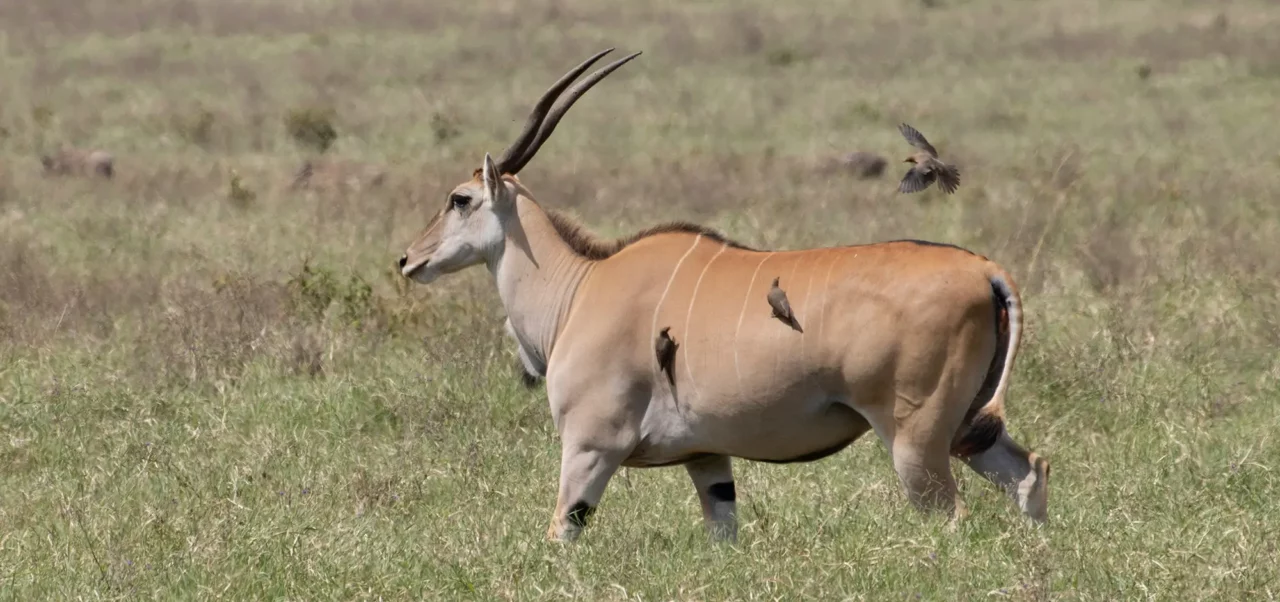
Paintings and engravings depict animals that have n/om, such as lions, and large herbivores such as eland, kudu, giraffe and elephant. The San say that these animals are ‘strong’ because they have n/om. Their physical characteristics and San beliefs about them define what kind of n/om an animal has. Eland n/om is different from elephant n/om for example. N/om is found in different parts of an animal’s body such as fat, marrow, certain bones and muscles, in the horns, tails, blood and urine. These are used in different ways for healing and for other activities.
In the Maloti Drakensberg the area that has been most intensively studies, images of certain dance postures, nasal bleeding, healing, transformation, human animal conflations seem to emphasise the work of owners of n/om, referred to as shamans in the rock art literature.
Elsewhere the emphasis seems to be on other rituals and themes such as men and women’s intitiation.
Images of men with hunting equipment are amongst the most common paintings in many parts of southern Africa. Perhaps because of their apparent simplicity they are amongst the most challenging for archaeologists to understand.
Rock art regions in southern Africa
There are paintings and engravings throughout southern Africa. Their geographical distribution doesn’t relate to today’s national and provincial boundaries—it relates to the geomorphology (rock formations) and hydrology (river systems) of the subcontinent. There are differences in the styles and subject matter in the rock art between these different bodies of rock art but there are areas of overlap between them. It’s often possible to guess where a painting or engraving comes from based on style and subject matter but it’s easier to see similarities and differences than it is to explain them.
Namibian rock art
Namibia has hundreds of rock art sites, both paintings and engravings. These occur in areas that are associated San/Bushman archaeology and also with Khoe-speaking groups such as Khoekhoe people. The rock paintings are concentrated in mountainous parts of the country in three main areas: Erongo Mountains, The Spitzkoppe, and Daureb (Brandberg). Engravings are made on flat rocky areas all over the country. In the northern part of Namibia there are many engravings of spoor and footprints. Many of the spoor are of large herbivores, especially giraffe. The site of /ui ǁaes (Twyfelfontein) is the best known of these and is one of the most visited rock art sites in southern Africa
Engravings in the south include many sites with geometric/schematic patterns or designs. These are probably the work of Khoekhoe herder people. Some researchers think that this kind of rock art played a role in women’s initiation ceremonies.
Namibia Ekuta – George Stoll
Botswana Matsieng footprints
Botswana
The Tsodilo Hills in northwest Botswana are four quartzite hills renowned for their rock art. The hills have a dense concentration of rock art that includes San hunter-gatherer paintings of eland, rhinoceros, giraffe, zebra and elephant amongst others. There are also handprints and finger-painted designs.
Matsieng engraving site is flat outcrop of coarse sandstone about 40 few kilometres northeast of Gaborone. It is traditionally regarded by Batswana as a ‘creation site’ at which Matsieng, the first Motswana, emerged from a hole in the ground. There are several engravings of human footprints at the site.
Zimbabwean rock art
Zimbabwe has some of the richest and best-preserved San rock art sites in southern Africa some of which include types of images (such as the formlings) that are very rarely painted elsewhere. They are well worth visiting. The paintings are made on granite formations in overhangs formed by hemispherical weathering. This creates some very large and spectacular places in which to paint. Zimbabwe has some of the oldest dated San rock art in southern Africa, though the dates come from radiocarbon dates on material associated with the paintings, not the paintings themselves. There are concentrations of rock art in the south of Zimbabwe, in the Matobos, in the Mashonaland provinces and in the southeast.
Giraffe painting Ntswatugi Zimbabwe
Lesotho Ha sekonyela
Lesotho
Lesotho includes the Maloti mountains in the east and lower altitude plains and sandstone plateaus in the south and west. The rock art of the Maloti-Drakensberg spans South Africa and Lesotho and is a good example of how history and political boundaries have divided up a painting area. There are hundreds of rock art sites with detailed paintings made in sandstone overhangs and on boulders. Some paintings in the eastern highlands of Lesotho were made on basalt.
There is another, more recent kind of rock art in Lesotho and in parts of neighbouring South Africa in KZN and Eastern Cape. These are paintings of cattle, horses and raiding and were made by multi-ethnic groups who carried out cattle raids on farmers living on farms in the foothills of the Drakensberg, KwaZulu-Natal
Eswatini
Eswatini has only a few rock art sites, one of which, Ntsangwini, is open to the public.
eSwatini Ntsangwini shelter
Limpopo Goudrivier
South Africa
LIMPOPO
There is rock art of the three southern Africa traditions (San hunter-gatherers, Khoe herders, Bantu-speaking farmers) in the Limpopo, often in proximity or in the same shelters. The rock art occurs in several areas.
The central Limpopo basin at the confluence of the Limpopo and Shashe Rivers is rich in rock art.
The Makgabeng Plateau is a major rock art complex in the north, with Bantu-speaking farmer art (known as ‘Late White’ paintings), possible Khoe-speaking herder art and San/Bushman rock art. Here is where we see interaction between Bantu-speakers and San peoples in the form of paintings that were made by both groups in the same shelters.
The Soutpansberg escarpment also has several rock art sites
In the Waterberg range San hunter-gatherers and Bantu-speaking farmers lived in proximity to each other from about 1600 years ago (Wadley & Laue 2025). These two groups had different painting traditions.
DRAKENSBERG: KWAZULU-NATAL AND EASTERN CAPE PROVINCE
Together with Lesotho, the rock art of the Maloti-Drakensberg, which includes KwaZulu-Natal and Easter Cape Province in South Africa, are amongst the best-known paintings and well-preserved rock art in southern Africa. Most of the interpretive work published on southern African rock art has focussed on the paintings of the Maloti-Drakensberg. Much of the South African side of the Maloti-Drakensberg is a World Heritage Site. There are many options for people to see San rock art in these two provinces.
Further east in KwaZulu-Natal around Muden, 20th century Zulu speakers have engraved what are interpreted as homesteads.
Eastern Cape – Cloebert
EASTERN CAPE
The Stormberg in Eastern Cape Province has many San hunter-gatherer rock art sites and some very well-preserved paintings, including the so-called ‘Valley of Art’ so named by the South African artist Walter Battiss.
In the south of the province are the folded mountain belt that includes the Kammanassie, the Kouga and Baviaanskloof in which there are many rock art sites. These include the ‘Swift people’ a clearly recognisable distinctive motif that spans the Western and eastern Cape provinces.
FREE STATE PROVINCE
The eastern Free State Province which borders on Lesotho, has a wealth of rock art painted on sandstone. Further west towards the Northern Cape Province are engravings.
UNESCO World Heritage sites
Mpumalanga Vapour trail
MPUMALANGA
There is rock art in the highveld higher altitude western part of Mpumalanga and in the low-lying parts of the northeast part of the province.
In the highveld areas to the west around Hendrina and Corolina there are some rock art painting sites on sandstone including some important paintings that could be linked to initiation rites of Khoi-speaking herder peoples.
One of the best-known engraving sites in Mpumalanga is the Boomplaats rock engraving site complex in Mashishing (Lydenburg). The engravings were made by the Koni in the archaeological period called the Late Iron Age around 1650. The Koni used stonewalling to construct terraced fields the remnants of which can still be seen. Boomplaats was declared a National Heritage Site in 2022.
There are hundreds of San rock art sites around Blyde River, White River, Mbombela, and the Kruger National Park. The rock art sites are located on granite koppies. Characteristic paintings include kudu, elephant, and sable.
NORTHERN CAPE & NORTH-WEST PROVINCE
South Africa’s wealth of rock engravings is concentrated in the Central Plateau (900-1200 m altitude) in the Northern Cape and North West Province. There are also finger-painted designs and schematic animal paintings in the Langeberg, Koranaberg, Kuruman Hills and Ghaap escarpment, all of which are in the Northern Cape.
NORTHERN CAPE & NORTH-WEST PROVINCE (continued)
In the south is the Great Karoo, a flat, semi-arid, and dotted with shiny black dolerite koppies and rock outcrops. Engraving sites are often on slightly higher ground overlooking pans and on mountaintops. The engravers used pecking and scraping techniques to create contrast between the black rock and the light brown surface underneath. There also rock gongs in the Great Karoo: these are rocks that are balanced so that they resonate when struck in the sweet spot with a stone, making a ringing sound.
NORTHERN CAPE & NORTH-WEST PROVINCE (continued)
Along the streams and rivers of the Great Karoo is another kind of art. These are fingerpainted designs and motifs made in sandstone rock overhangs at places where there is permanent water. These might be Khoisan women’s initiation sites: initiates were ceremonially introduced to the water snake that was said to live there. This would make her lucky in her future life.
There are also several more recent engravings that date from European colonial settlement in the 19th century and into the early twentieth century. These are very finely detailed images, probably made with a metal blade, of horses, people in European dress, windmills, cars.
Rock Art in Southern Africa
NORTHERN CAPE & NORTH-WEST PROVINCE (continued)
Gariep, Vaal and Modder River basins
To the northeast, the shrubland of the Great Karoo grades into the savannah and thornveld of the Gariep and Vaal and Modder River basins. Before European colonialism, these areas were occupied by groups of Bushman hunter gatherers, Khoisan pastoralists and Tswana pastoralists and farmers.
There are two very different-looking styles of rock art: the Bushman engravings of animals (especially eland), and the geometric designs. The geometric designs like those close to the Kalahari are usually close to water. Sometimes the styles occur at the same place.
NORTHERN CAPE & NORTH-WEST PROVINCE (continued)
Driekopseiland
Driekopseiland, on the Riet River (Modder River basin), southwest of Kimberley, is the second largest engraving site in South Africa (Fock & Fock 1989: 149). It is an extensive site on a pavement of andesite rock over which the river flows. Here people pecked out hundreds of geometric designs and motifs. The engravings sometimes get flooded or covered by sand. The engravers would have taken this into account; the reasons they made the engravings there has something directly to do with the significance of the river. As with the similar-looking finger-painted designs in the Great Karoo mentioned earlier, these engravings could be linked to women’s initiation rites and the introduction of an initiate to the water snake that personified that water source.
Northern Cape Driekopseiland
NORTHERN CAPE & NORTH-WEST PROVINCE (continued)
Wildebeestkuil
The engraving site Wildebeestkuil is outside of Kimberley on land owned by the !Kun and Khwe people. Here are engravings both in the Bushman hunter-gatherer tradition of animal images, as well as pecked geometric designs and motifs. Many of the hunter-gatherer engravings depict large herbivores – elephant, rhinoceros, and eland.
GAUTENG
Redan is one of Gauteng’s only engraving sites. It is on an outcrop of sandstone on a tributary of the Vaal River, in the highveld grassland (Vereeniging). The engravings are mostly pecked geometric designs, with some eland and feline engravings. People also enlarged and smoothed the edges of natural holes on the rocks.
There are also engravings on sandstone near the Vaal River but these are weathering away rapidly as a result of damage from water.
There is a Late White painting on the Suikerbosrand in the vicinity of a large settlement of a Tswana group who lived there from the 15th century until about 200 years ago.
Gauteng Redan
Rock Art in Southern Africa
GAUTENG/NW PROVINCE: MAGALIESBERG ENGRAVINGS
These are the rock art sites closest to Gauteng in the Magaliesberg, part of which is included in Gauteng, the other in North West Province. These sites are very beautiful, incised outline engravings on large rounded hornfels boulders of eland, black rhino, zebra, and lion amongst others. There are a few engravings of people. South Africa’s first officially appointed archaeologist Cecil Van Riet Lowe (1944:329) said of these engravings that:
‘the engravings are undoubtedly among the most beautiful and skilful that have ever been discovered. As drawings they reached artistic heights that were seldom, if ever, surpassed in prehistoric times. They certainly represent the climax of artistic achievement in prehistoric art in south Africa.”
The engravings are all on private land. There is also a collection of engravings from the Magaliesberg in the Origins Museum at the University of the Witwatersrand in Johannesburg.
WESTERN CAPE
Cederberg is the best-known area for rock paintings in the western part of Western Cape Province. It is the most popular rock art destination and much of it is a wilderness area. There are hundreds or even thousands of rock art sites throughout the area and it is easy to access some of the most interesting and well-preserved paintings in the area.
There is also rock art in the Gifberg, Doring River and Koebee to the north of the Cederberg as well as in the south eastern parts of the province around Oudtshoorn and to the east, including the gamkaberg, Attaquas, Swartberg and Kammanassie. These paintings that are every bit as interesting as the better-known Cederberg rock.
Western Cape Mike’s shelter
San engravings in southern Africa
San engraving sites occur throughout southern Africa, and especially in Botswana, Zimbabwe, Namibia and South Africa. Some of these engraving sites also have schematic (or geometric) images which some researchers suggest represent a different rock art tradition associated with Khoe-speaking pastoralist peoples.
In South Africa engravings occur inland on the Central Plateau (900-1200 m altitude) in Northern Cape and North West Provinces. Paintings occur in the mountain ranges along the edge of the plateau.
SAN ENGRAVINGS (continued)
The significance and meanings of paintings and engravings are generally the same but there are differences between them in emphasis of images and the layout of rock art sites.
Engravings are often in clusters on rock pavements, large rocks and boulders and smaller rocks. The engravings are made on the different rock types that occur across southern Africa. In the Great Karoo (Northern Cape Province) the San made engravings on shiny black dolerite koppies and rock outcrops. These engraving sites are often on slightly higher ground overlooking pans and on mountaintops. Elsewhere to the north and northeast in Northern Cape Province and North West Province and Botswana the engravings are on andesite and in one small area, pyrophyllite. There are engravings on sandstone surfaces in various part of southern Africa.
SAN ENGRAVINGS (continued)
The engravers tended to focus on making images of animals, including ostrich, rhinoceros, eland, elephant, giraffe. In comparison with rock paintings there is less emphasis on depictions of dance, healing, the ‘taming’ of animals, or recognisable rain-making activities. Human footprints were engraved at sites in Northern Cape Province and North West Provinces and north of the Gariep River in Botswana. However, that are commonly found. In parts of Namibia, Zimbabwe and Limpopo Province, South Africa there are engravings of animal spoor.
Who are the San/Bushmen?
‘San’ and ‘Bushman’ are two commonly used words for southern Africa’s aboriginal/native/indigenous people. Their genetic lineage (ancestry) is the most divergent and variable lineage of all humanity. Their genetic ancestry goes back ~160 to 100 thousand years ago. Their cultural origins can be traced to around 20 000 years ago according to archaeological research.
San/Bushman peoples speak indigenous click languages. Before the arrival of peoples from the north the ancestors of San people lived off the land, gathering wild foods, collecting and trapping small animals and hunting larger animals. In the 21st century people of San/Bushman descent are members of 21st century society like any other people. They are not fossil survivors of a quaint past [Parkington & Dlamini 2015: 131]
‘San’ or ‘Bushman’: Which term is more correct and respectful?
There is no easy, definitive answer to this question. San/Bushman groupings were never a single entity or nation, and they did not have a collective term for themselves. There were probably hundreds of ethnic identities of San/Bushmen across southern Africa. Most of these identities have disappeared. Some of the well-known ethnic groups include the Ju/’hoansi, Khomani, |xam amongst others.
RESPECTFUL TERMS (continued)
These groups speak different languages, some of which are more different from each other than Hindi or Sanskrit is from English. San/Bushman people are genetically diverse and have different settlement patterns, kinship systems and economic practices. We should not be surprised by this variation and diversity: as the anthropologist Alan Barnard (2019:1) said: “Given that they have lived in southern Africa for at least 25 000 or maybe 50 000 years, why would we expect otherwise?”
Quote: in my view there cannot be a true correct term in any absolute sense. ‘San’ is just as much an image or collection of images as ‘the Bushman’, and each term has both positive and negative connotations [Barnard 2007: 5]
RESPECTFUL TERMS (continued)
Both ‘San’ and ‘Bushmen’ have positive and negative connotations. ‘San’ is a Nama word that means ‘bush-dweller’ or even ‘vagrant’. This is essentially the same meaning as ‘Bushman’. Historically, the Dutch and English used the words ‘San’, ‘Saan’ and ‘Sonqua’ as well as ‘Bushman’. These names emphasise the fact that in the past these people lived as hunter-gatherers and did not own livestock. Bantu-speaking communities used the terms ‘AbaThwa’ and ‘Baroa’. All these terms were imposed by non-San groups. In contemporary southern Africa people sometimes describe themselves as ‘San descendants’ or ‘Bushman’ or ‘Boesmans’ or sometimes ‘Khoisan’ or ‘Khoesan’.
RESPECTFUL TERMS (continued)
Ethnic San groups have various names for themselves depending on the context in which they are speaking. This is what a ‘San’ or ‘Bushman’ has to say about the issue:
Quote: “If I meet a Tswana or other Bantu I say I am a Kua or a Mosarwa, but if I meet a Naro or any other people of my people I refer to myself as a Dcuikhoe. When speaking Setswana, I call myself a Mosarwa, but when speaking English I use the term Bushman or San… I do not care whether the terms San, Bushman and Basarwa are popular in academic field or not. My aim is to fight against such stereotypes in the struggle to maintain my identity. I am a Kua not a San.
Quote by Kuela Kiema (2010: 67) in Barnard 2019: 8)
San/Bushman languages
Linguists identify two main San/Bushman language families: Ju Hoan and Tuu. Both families incorporate click sounds and may sound superficially alike to non-speakers but in many cases, they are mutually unintelligible. The click sounds themselves do not define the language. Each language has its own building blocks (lexical items) and grammar (the way in which words are arranged) that characterise a particular language.
SAN/BUSHMAN LANGUAGES (continued)
Ju-Hoan languages are spoken in the northern part of southern Africa. Tuu languages such are spoken in the southern parts. Within each of these language families are several language groups. Each of these groups in turn includes many languages, many of which have disappeared without a trace.